The Rise of ‘Social SEO’: Replacing Hashtags with Keywords
Quick Summary
Platforms like Instagram, TikTok, and LinkedIn now prioritise keywords over hashtags to surface content in search and feeds.
Captions, on-screen text, and spoken audio are key signals, so writing with intent and clarity matters more than ever.
Social SEO is now essential for visibility across industries, optimise your content like it’s search-driven, because it is.
Table of Contents
There’s a quiet revolution happening in your social feed. Search boxes have become smarter. Captions matter more than hashtags. And the brands winning on TikTok, Instagram, and LinkedIn in 2026? They’re not just posting trends, they’re optimising for search.
This is Social SEO, and if you’re still relying on hashtags, you’re already behind.
What is Social SEO (and Why Should You Care)?
Social SEO is the practice of using keywords to improve content discoverability on social platforms. Instead of relying on hashtags or viral audio, you're helping your content get found by the words you use in your caption, spoken audio, video text, and bio. Like GEO & AEO, social SEO has stemmed from traditional SEO, which is the process of improving a website (technical structure, content relevance, and more) to increase its visibility and organic traffic in search engine results pages.
Every major platform, from Instagram to LinkedIn to TikTok, has confirmed this shift. Instagram Head, Adam Mosseri, said:

"While hashtags can help people interested in specific topics find your content, they won’t necessarily increase your content’s visibility."
- Adam Mosseri, Head of Instagram
Social media search is now more like Google than it used to be. And that means SEO principles finally apply, but only if you adapt.
From Hashtags to Keywords: What’s Changed In The Past Few Years?
Hashtags once ruled the social discovery game. But by 2026, they're crowded, spammy, and increasingly irrelevant to how platforms surface content. Instead, advanced AI and machine learning now parse the actual text, audio, and context of your content to decide where, when, and to whom it should be shown.
Here’s what’s changed:
Back in 2020, content discovery on social media relied heavily on hashtags and tag-based browsing. In 2026, discovery is driven by natural language keywords, search behaviour, and algorithmic context, making clear, intent-driven captions far more effective than a list of tags.
Platforms are indexing text like Google does. And if your content doesn’t include the words people are searching for, you’re invisible.
Why Keywords Now Outperform Hashtags
The benefits are clear and supported by data.
Better intent matching: Keywords reflect how people actually search.
Less clutter: Hashtags are often generic or gamed (like #foryou or #trending).
Higher engagement: HubSpot’s 2024 report shows 67% of marketers are now prioritising keyword strategies over hashtags for social discovery.
"We found that content with clear keyword alignment was 35% more likely to rank in TikTok search than equivalent hashtag-based content."
- Yancey Social x Personate 2024 Benchmark
Are Hashtags Still Worth Using in 2026?
It’s the question on every marketer’s mind: do hashtags still matter?
Short answer? Yes… But not in the way you’re used to.
Hashtags were once the hero of social discovery. Remember trending topics on Twitter? They helped creators and brands get in front of new audiences fast. But as social platforms have become smarter, the role of hashtags has evolved, and so should your strategy.
Why Hashtags Don’t Work Like They Used To
In 2026, platforms are placing more weight on behavioural signals and keyword context than hashtag clusters. Here are some platform updates to back up the case:
Instagram removed the ability to follow hashtags, limiting passive exposure. And, in November 2025, Reddit users noticed that hashtags on Instagram were limited to only 3.
TikTok and Instagram now prioritise captions, audio, and on-screen text for content ranking
LinkedIn has shifted to natural language indexing, where keywords in sentences matter more than tags
X (formerly Twitter) has deprioritised hashtags in ads, calling them “visual clutter”
So are hashtags obsolete? Not quite. But they’re no longer the main traffic driver.
The New Role of Hashtags
Hashtags in 2026 work more like metadata than marketing. They support discoverability, but they don’t lead it. Here's how they can still be useful when used with intention:
1. Content Categorisation
Hashtags help platforms understand what your content is about, especially when your caption is minimal or lacks keywords. Use them to reinforce the topic or niche of the post.
Example: If your Reel is about budgeting tips for freelancers, using #FreelanceFinance or #BudgetTips helps reinforce context.
2. Search Support (but not the lead role)
Hashtags can still surface your content in in-app searches, but only when paired with quality captions. They now act more like secondary keywords than search triggers.
Tip: Choose hashtags that reflect real search intent, not just trends. Think: #ClientOnboardingProcess instead of #MotivationMonday.
3. Audience Signalling
Hashtags can tell the algorithm who might care about your content. When used well, they contribute to more relevant reach. But if they’re generic or misaligned, they’ll dilute your visibility.
Tip: Skip mass tags like #love or #viral. Instead, use 3 niche-specific, high-intent tags your target audience is likely to follow or search.
4. Long-Term Searchability
While hashtags won’t spike your engagement, they can keep your post searchable over time, especially on TikTok or Instagram’s Explore tab. Think of them as passive SEO support.
Platform-Specific Hashtag Guidelines 2026
Use 3 targeted hashtags, ideally at the end of a keyword-rich caption. Treat them as category tags, not visibility boosters.
TikTok
Still helpful for participating in trends, challenges, or surfacing related content. Use trending hashtags alongside spoken and written keywords.
Supports hashtag search, but prioritises plain-text keywords. Add a few relevant tags at the end of your post but don’t rely on them to drive reach.
Threads
Only one tag per post is allowed. Focus on using clear, searchable language in your copy.
YouTube & Pinterest
Keywords in titles and descriptions have far more impact than hashtags. Use them sparingly, if at all.
How to Use Hashtags Strategically in 2026
What to Avoid
Overloading posts with 20+ hashtags
Using the same copy-paste block across every post
Chasing trending tags with no relevance to your content
Relying on hashtags to “hack” the algorithm
What Works Now
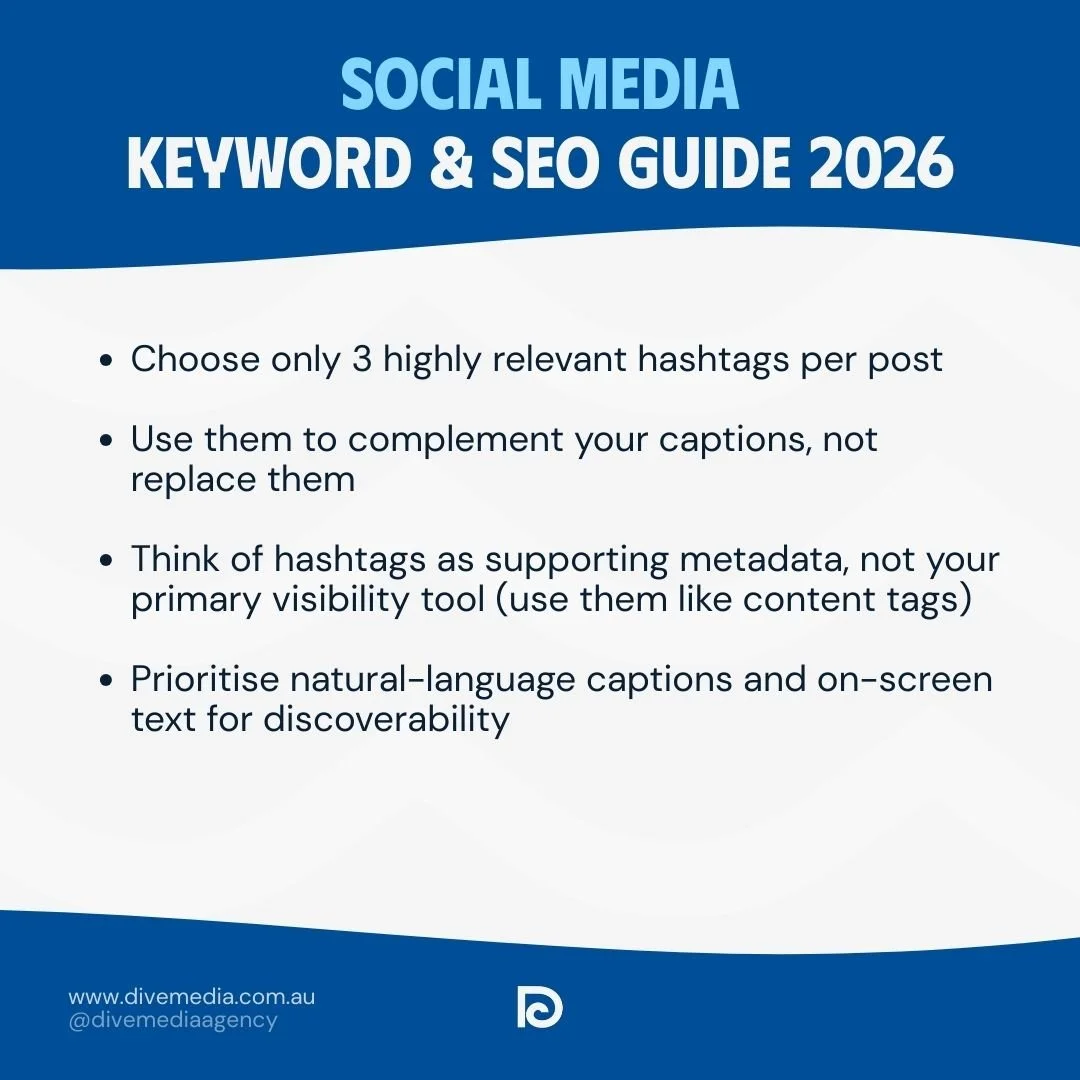
Choose 3 highly relevant hashtags per post
Use them to complement your captions, not replace them
Think of hashtags as supporting metadata, not your primary visibility tool
Prioritise natural-language captions and on-screen text for discoverability
How Social SEO Works According to the Social Platforms
Instagram now indexes the actual text in captions and bios, as well as your on-screen captions and text in Reels. Its internal search engine can surface posts based on full phrases, like "best copywriting tips", not just hashtags.
Instagram’s own guide still confirms:
"Using relevant keywords in your caption and bio helps Instagram understand what your content is about."
- Instagram for Business
Do: Optimise captions using the same natural language your audience uses in DMs or search bars.
Don’t: Rely on “#motivation #instagood” anymore, they’re not doing the work.
TikTok
TikTok has leaned into multimodal search. Its algorithm analyses spoken language, on-screen text, captions, and even sounds to classify your video.
For example, a TikTok search for “meal prep ideas” now brings up videos where those exact words are:
Spoken in the audio
Written in the on-screen text
Included in the video description
TikTok’s 2024 update on their Creator Center states:
"Captions, spoken words, and text overlays are all signals we use to match content with user interests."
- TikTok Creator Center (Source)
LinkedIn is also turning into its own search engine. This is great because every field in your profile and every post you write is an opportunity to rank.
Key areas to optimise:
Your headline and About section
Article headlines and body copy
Post copy (especially first 3 lines)
According to LinkedIn Engineering:
“We prioritise content that matches a user’s professional intent - including topics, roles, and industries.”
- LinkedIn Engineering Blog
Social SEO Strategy: How to Optimise Across Platforms
Here’s a practical guide to implementing Social SEO:
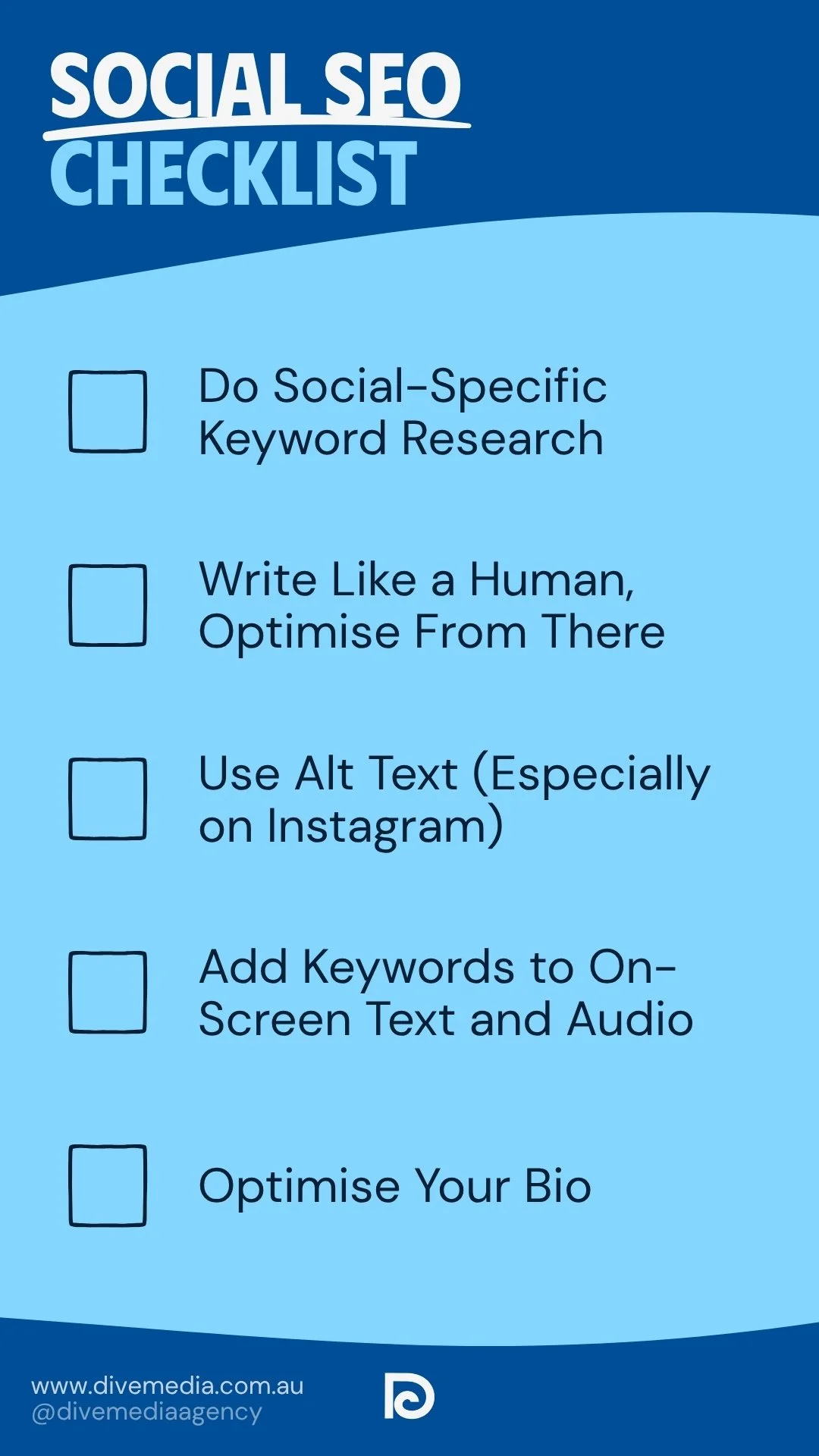
✅ Do Social-Specific Keyword Research
Use platform search bars (type partial phrases to see autofill)
Use Google Trends for rising topics
Try Exploding Topics for niche terms (explodingtopics.com)
✅ Write Like a Human, Optimise From There
Focus on clarity, not keyword stuffing
Integrate keywords into sentences, not lists
✅ Use Alt Text (Especially on Instagram)
Treat alt text like a mini meta description
Write concise, descriptive summaries using target keywords
✅ Add Keywords to On-Screen Text and Audio
Especially important for TikTok, Reels, and Shorts
Helps AI categorise your content
✅ Optimise Your Bio
Make your expertise obvious
Include your niche, industry, or service keywords
Does Social SEO Work?

We know this strategy works, because we tried it! Here’s an example of a client’s recent post with Social SEO strategy in place.
You’ll see that it was found by over 1K new people from Instagram Search.
Case Study Comparison: Hashtags vs Keywords
In one of the most cited experiments to date, Hootsuite set out to test whether keyword-rich captions outperform hashtags on Instagram. The experiment was sparked by Instagram CEO Adam Mosseri’s announcement that hashtags "don’t really matter" anymore, a statement that sent shockwaves through the social media community at the time.
To validate the claim, Hootsuite published ten Instagram posts using a mix of trending visual topics (like beaches, peonies, and French toast). Half were written with keyword-focused captions, while the other half used 3–5 hashtags without additional context. All posts were scheduled during optimal times using Hootsuite’s platform.
The results were clear: keyword-optimised captions consistently outperformed hashtag-only posts in both reach and engagement. Posts with descriptive, keyword-rich copy saw an average of 30% more reach and higher engagement rates across nearly every topic tested.
FAQs: Social SEO in 2026
-
Social media SEO is the practice of improving your content’s visibility within social platforms by using keywords, structured captions, and platform-specific optimisation techniques. It helps your posts appear in in-app search results, explore feeds, and recommended content sections, similar to how traditional SEO helps web pages rank on Google.
-
To use SEO for social media, start by researching the keywords your audience is actively searching for, using platform search bars, Google Trends, or tools like TikTok Creative Center. Then, naturally include those keywords in your captions, bios, on-screen text, spoken audio, and alt text. Each platform has its own preferences, but clear, intent-driven language always performs better than generic hashtags.
-
SEO social media optimisation is about aligning your social content with the way people search on platforms like Instagram, TikTok, LinkedIn, and YouTube. It involves using relevant keywords in your content, optimising captions for clarity, and structuring your posts so algorithms can easily understand what they’re about, boosting your reach without relying on hashtags alone.
-
Hashtags still help with categorising your content, but they no longer drive reach like they once did. Most platforms now prioritise context, intent, and engagement over hashtags. Used correctly, hashtags support content discoverability, especially for niche communities or trends, but they should be treated like secondary metadata, not your main visibility strategy.
-
Social media keywords are the actual words or phrases people use when searching within a platform, like “marketing tips for small business” or “easy meal prep ideas.” To use them effectively, write captions in natural language using those phrases, and reinforce them in your on-screen text, audio, or profile sections. Keywords help platforms understand your content and match it to the right users.
-
Yes, but their role has changed. In 2025, hashtags are no longer a major driver of reach, but they still support content categorisation and niche discoverability. Platforms like Instagram and TikTok now favour natural language and contextual signals over tag volume. That said, using a few highly relevant hashtags can help your content reach specific communities or appear in certain search results, especially when your caption is short or lacks key phrases. Use them strategically, not excessively.
-
Not at all. While B2B companies often lean into thought leadership and keyword targeting, Social SEO benefits B2C brands, creators, influencers, and ecommerce businesses just as much. Anyone trying to increase visibility, grow an audience, or generate leads on platforms like TikTok, Instagram, or LinkedIn can use keyword optimisation to their advantage. The key is to understand what your ideal audience is searching for, and speak their language clearly.
-
Start by listening to your audience. Pay attention to the phrases they use in comments, DMs, reviews, and forums. Then test those terms in platform search bars to see what autofills or surfaces in results. Tools like Google Trends, TikTok Creative Center, Instagram Search, and AnswerThePublic can help you identify high-interest topics and search patterns. Look for keywords that align with your expertise, solve real problems, and reflect natural language.
-
Yes, trending audio still plays a big role in reach, especially on platforms like TikTok and Instagram Reels. But audio alone isn’t enough. For best results, pair it with spoken keywords, subtitle overlays, and strong captions that reinforce the message of your video. This helps the algorithm understand what your content is about and who it’s for. Treat trending sounds as an engagement boost, not your core discovery strategy.
-
It can, but only if it's high quality, original, and clearly edited for humans. Platforms are increasingly prioritising content that demonstrates expertise, intent, and engagement. AI tools are great for streamlining content creation, but avoid relying on generic outputs. To succeed with Social SEO, your content still needs a clear voice, relevant keywords, and strong formatting, all things that show the algorithm (and your audience) it’s worth watching and sharing.
What’s Next for Social SEO?
As AI continues to evolve, platforms will prioritise meaning over metadata. That means content discoverability will depend on:
Natural language
Intent-rich phrasing
Relevance to user needs
In short: write for humans, optimise for machines. The brands that will win tomorrow are the ones that treat social like search, with strategy, clarity, and context.